
The boot comes down hard on the metal decking.
Three inches away, a loose cable rests in the dust.
The veteran worker does not see it.
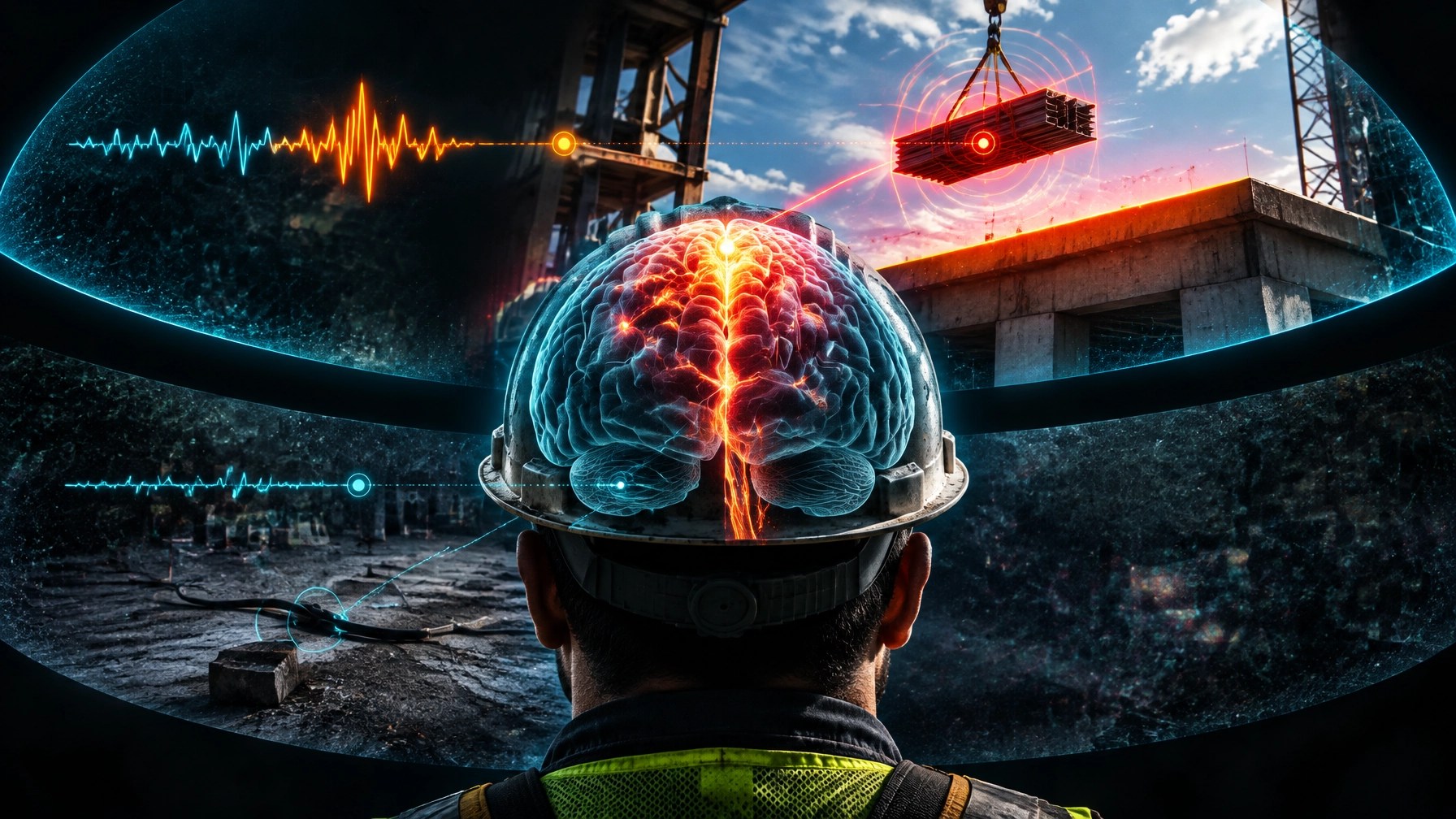
His eyes are already fixed on the roof edge thirty feet ahead, where one missing section of guardrail opens directly to the sky. His body reacts before the thought arrives. He stops. His shoulders tighten. The drop has reached him at the speed of instinct.
The cable has not.
That is the scene I keep returning to when I read the recent EEG research on older construction workers. Not because the experienced worker is careless. Not because he has lost his edge. Almost the opposite.
Years of exposure have sharpened his brain for the hazard that can kill him immediately.
The fatal edge receives the first alarm.
The cable waits in the dark.
The study, published in the Journal of Management in Engineering, found that older construction workers showed stronger preattentive responses to critical hazards, including falls from height. For struck-by hazards, the effect was linked to experience. But when the hazard was a routine same-level trip, their attentive processing was substantially weaker.
The pattern is uncomfortable because it refuses the easy story about age and safety. Older workers are not simply more vulnerable. They are not simply safer because experience has accumulated. Their hazard recognition has been shaped by consequence, repetition, memory, and survival.
The brain is making decisions about what deserves attention before the worker has consciously decided to inspect the scene.
That distinction matters.
The hazard that reaches the brain first
Preattentive processing is fast, blunt, and protective. It allows the nervous system to register a possible threat before full conscious analysis begins. A roof edge, an unstable load, a vehicle moving through a blind spot: these signals carry enough danger that the brain gives them priority.
The older workers in the study showed stronger early neural responses to critical fall hazards. Experience may have trained their systems to recognize the visual structure of danger: the exposed edge, the unstable position, the trajectory of a struck object, the gap where a person could disappear.
The body has seen versions of that pattern before.
It remembers near misses. It remembers the sound of a metal object hitting concrete. It remembers the sudden silence after someone realizes they are too close to an edge. Experience is not just a collection of lessons stored in the mind. It changes what the mind notices first.
That advantage appeared again with struck-by hazards. Older workers were less likely to miss those critical signals when other information competed for attention. The early warning system was working.
But the same system can create a blind spot.
A cable across a walkway does not announce itself with the same force. It is familiar. It is common. It is often treated as a housekeeping issue rather than a safety event. It does not carry the immediate visual signature of a fatal fall, even though it can still cause a serious injury, especially when a worker is carrying a load, moving quickly, or stepping from an elevated surface.
The brain ranks it lower.
Not because the cable is harmless.
Because the cable is ordinary.
Signal detection is not the same as seeing
Signal Detection Theory gives me a useful way to understand this without blaming the person standing on the roof.
The theory separates two problems that safety programs often collapse into one. The first is sensitivity: can the worker detect the signal? The second is attention allocation or decision criterion: which signals receive enough priority to be acted on?
A person may be highly sensitive to a fatal fall hazard and still allocate too little attention to a cable.
That is not a contradiction. It is the way limited attention works.
Every worksite contains more information than the brain can process with equal intensity. Edges, openings, moving equipment, tools, noise, weather, instructions, body position, production pressure, and the next step in the task all compete for access. The brain filters. It has to.
Experience improves that filtering in some situations. It helps a veteran worker detect the hazard that younger workers may overlook. It may create a strong internal threshold for anything associated with catastrophic injury. That is why the roof edge lights up immediately.
But the same experience can quietly reduce the perceived value of routine inspection. A veteran worker may have crossed hundreds of cluttered walkways without falling. The cable becomes part of the background. Its presence is registered weakly, if at all.
This is where hazard recognition training can fail. We teach people to “look for hazards” as though all hazards arrive with equal visual and emotional weight. They do not.
A fatal edge and a loose cable can occupy the same visual field while receiving entirely different levels of neural processing.
The worker is not choosing to ignore the cable in a deliberate, conscious way. The system has already classified it as less urgent.
That classification may have been adaptive for years. It may also be wrong today.
Experience can protect: and narrow: the field
I do not want leaders to read this research and turn older workers into a risk category. That would be another blunt instrument.
Age is not a simple strength or vulnerability. Experience can improve early hazard detection, especially for high-consequence events. It can reduce inattentional blindness to struck-by hazards. Those are real safety assets, and organizations should preserve them.
But expertise also creates expectations. When a familiar worksite looks familiar, the brain predicts what comes next. The veteran worker sees the edge because it violates the expected pattern. The loose cable may not. It belongs to the visual language of the site.
This is how routine hazards disappear without anyone deciding to normalize them.
A supervisor sees an experienced worker walk past the same cable and assumes the cable was judged acceptable. The worker may not have consciously seen it. A younger worker notices the cable but does not challenge the person with twenty years on the job. The condition remains. By the next shift, it is no longer a condition. It is part of the environment.
That is how a small hazard becomes a quiet organizational habit.
The fix is not another generic reminder to pay attention. The fix is to redesign how hazard recognition is practiced.
A high-quality neuroscience-informed observation process should ask what the worker’s attention was actually doing, not simply whether the worker followed the rule. A strong safety resources program should distinguish between hazards that demand immediate interruption and hazards that require systematic visual reweighting.
The question is not, “Why did he miss the cable?”
The better question is, “What has taught this team that the cable does not deserve attention?”
Recognition must be tailored by hazard type
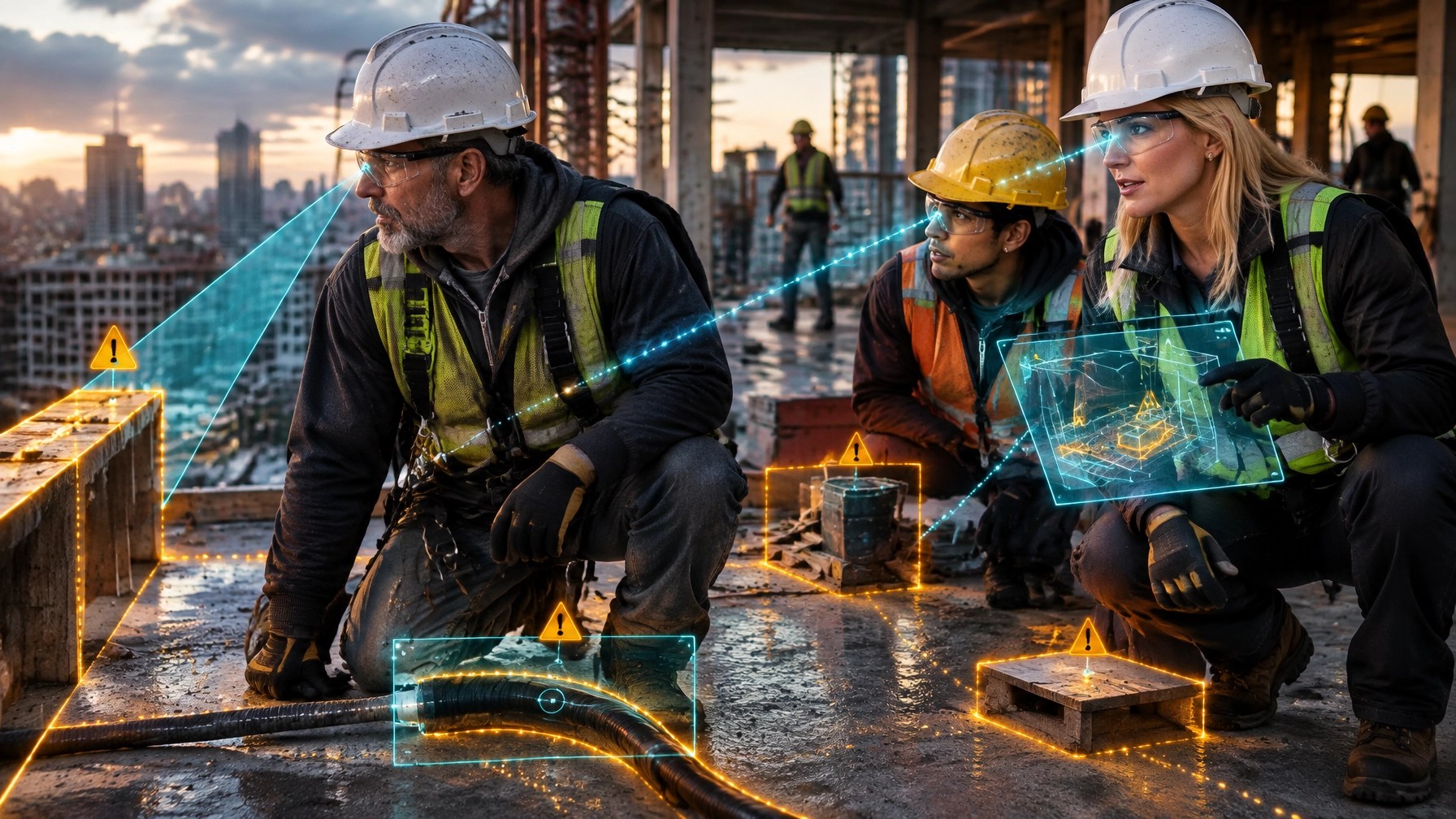
A younger worker may need more support recognizing the visual and physical signatures of a fatal hazard. An experienced worker may need deliberate reinforcement around routine, lower-severity hazards that have become perceptually quiet.
That does not mean separating workers into rigid age-based tracks. It means looking at the interaction between age, experience, hazard type, task demands, and work environment.
The training should change.
For experienced workers, a hazard recognition exercise might place a routine trip hazard beside a dramatic fall exposure and ask what was noticed first, what was missed, and what deserved action. The purpose is not to test memory. It is to expose the attention hierarchy already operating in the field.
The worksite should change, too. Housekeeping cannot depend on someone voluntarily noticing what the brain has learned to suppress. Cable management, protected walkways, clear access routes, visible edge protection, and physical separation all reduce the amount of attention required.
High-risk work should also have a stop-work system that does not require a worker to publicly defy authority. A physical veto card can give any worker a simple, visible way to suspend a task when a critical hazard appears. The card is not a confrontation. It is a control.
For high-consequence tasks, dual-key authorization should be required before work begins or resumes. One person confirms the task conditions. A second authorized person independently verifies the edge, energy source, access route, equipment, and environmental controls. Neither signature should be ceremonial. If either key is withheld, the work stops without penalty.
That system protects the veteran worker from having to rely on personal vigilance alone. It protects the newer worker from having to challenge experience with nothing but a raised voice. It moves the decision out of the social pressure of the moment and into the design of the work.

Field Note: The Age-Tailored Hazard Audit
Use this before a high-risk shift, after a layout change, or when the same hazards keep appearing in observations.
-
Walk the work area with at least one experienced worker and one less-experienced worker. Do not announce which person is expected to find which hazard.
-
Ask each person to identify the first three hazards they noticed, then compare the answers without ranking anyone’s performance.
-
Separate the hazards into critical, struck-by, fall-from-height, routine trip, access, visibility, and housekeeping conditions.
-
Check whether experienced workers detect the critical signals quickly but pass over routine trip hazards. If they do, add a deliberate routine-hazard scan to the task briefing and physical walkthrough.
-
Preserve the experienced worker’s high-consequence recognition by asking what visual cue triggered the early response. Capture that cue in training for the entire crew.
-
Remove cables, debris, uneven transitions, and clutter physically instead of relying on attention to compensate for them.
-
Issue physical veto cards for stop-work situations and explain that presenting one pauses the task without requiring a public argument.
-
Require dual-key authorization before high-risk work resumes after a changed condition, near miss, weather event, equipment movement, or loss of visibility.
-
Repeat the audit across different age groups, tasks, shifts, and site layouts. The purpose is not to label a worker. It is to find the hazards the team has stopped seeing.
I would rather discover that a veteran worker has quietly down-weighted a cable during a controlled audit than learn about it after a fall.
The roof edge still deserves the instant alarm. The cable deserves to come back into the field of attention.
What routine hazard have your most experienced workers quietly stopped seeing?
Scenes in this article are illustrative composites, not accounts of specific events.