
At 6:42 in the morning, the incident dashboard flashed red.
The report was complete. The location was logged. The time, task, department, severity rating, and immediate response were all sitting neatly inside the system. Someone had attached a photograph. Someone else had entered a corrective action. The notification had reached the right distribution list.
Then the screen went quiet.
Three months later, the same risk returned.
Different shift. Different worker. Same weak handoff. Same pressure to keep moving. Same small warning that never reached the people who could change the conditions around the work.
The organization had not failed to collect data. It had collected everything.
It had simply built a system that knew how to store an incident better than it knew how to learn from one.
That distinction matters. I have watched safety teams spend hours refining categories, dashboards, and reporting thresholds while the recurring hazard moves through the organization untouched. The data becomes polished. The learning becomes thinner.
A 2025 sociocultural study of staff and physicians at a large Canadian academic health science centre exposed this problem with uncomfortable clarity. Researchers interviewed 15 people about incident investigations and information sharing. The organization had robust processes for investigating incidents and distributing information. Yet learning remained difficult because of professional politics, privacy policies, improvement work organized around reporting, and an institutional focus on incidents with severe outcomes.
The information was moving.
The meaning was not.

When severity becomes the gatekeeper
Most organizations say they want early warning. Then they quietly define “worth learning from” as “bad enough to trigger a formal review.”
That threshold creates a blind spot.
A near miss with no injury gets classified, closed, and forgotten. A workaround that prevented harm disappears into a supervisor’s memory. A repeated equipment problem is treated as an inconvenience because nobody was hurt this time. A successful recovery is praised in the moment but never examined closely enough to reveal what made it possible.
The severe incident gets a room, a timeline, a committee, and a formal action plan.
The everyday signal gets a reference number.
This is how recurring risk survives inside a competent organization. Not because people do not care. Because the system teaches them which events deserve attention.
The study’s participants argued for a broader view: one that includes “learning-rich” events rather than relying only on the severity of the outcome. That shift sounds modest. It is not. It changes the central question from How much harm occurred? to How much can this event teach us about how work actually happens?
A small event can reveal a large weakness.
A smooth recovery can reveal a safeguard worth protecting.
A quiet workaround can expose the gap between the procedure written in an office and the task performed under real conditions.
The absence of injury does not prove the presence of control.
Information can travel without becoming learning
I have seen incident summaries travel through email, dashboards, safety meetings, portals, and executive reports. They arrive everywhere except the place where the operating conditions need to change.
Information sharing is necessary. It is not sufficient.
A report can be distributed without being understood. A lesson can be understood without being trusted. A trusted lesson can still be blocked by policy, hierarchy, privacy restrictions, professional boundaries, or competing performance goals.
That is where incident learning becomes political.
One group owns the classification. Another owns the process. A third controls the data. The people closest to the work may know exactly why the event keeps returning, but their explanation conflicts with the official account. The report is softened. The language becomes neutral. The uncomfortable detail is removed.
No one has lied.
The system has simply filtered out the part most capable of producing change.
Privacy protections matter. So does dignity. So does the separation of learning from punishment. But when privacy rules remove the operational context, when liability concerns make every sentence cautious, or when professional boundaries prevent people from examining the whole chain, the organization may preserve confidentiality while losing the lesson.
The Swiss Cheese Model gives us a way to see the full structure. The incident is not a single hole in one person’s attention. It is the alignment of weaknesses across multiple layers: policy, training, staffing, tools, supervision, communication, equipment, incentives, and leadership decisions.
If the review stops at the worker who touched the hazard, the organization has not investigated the incident. It has only located the final visible opening.
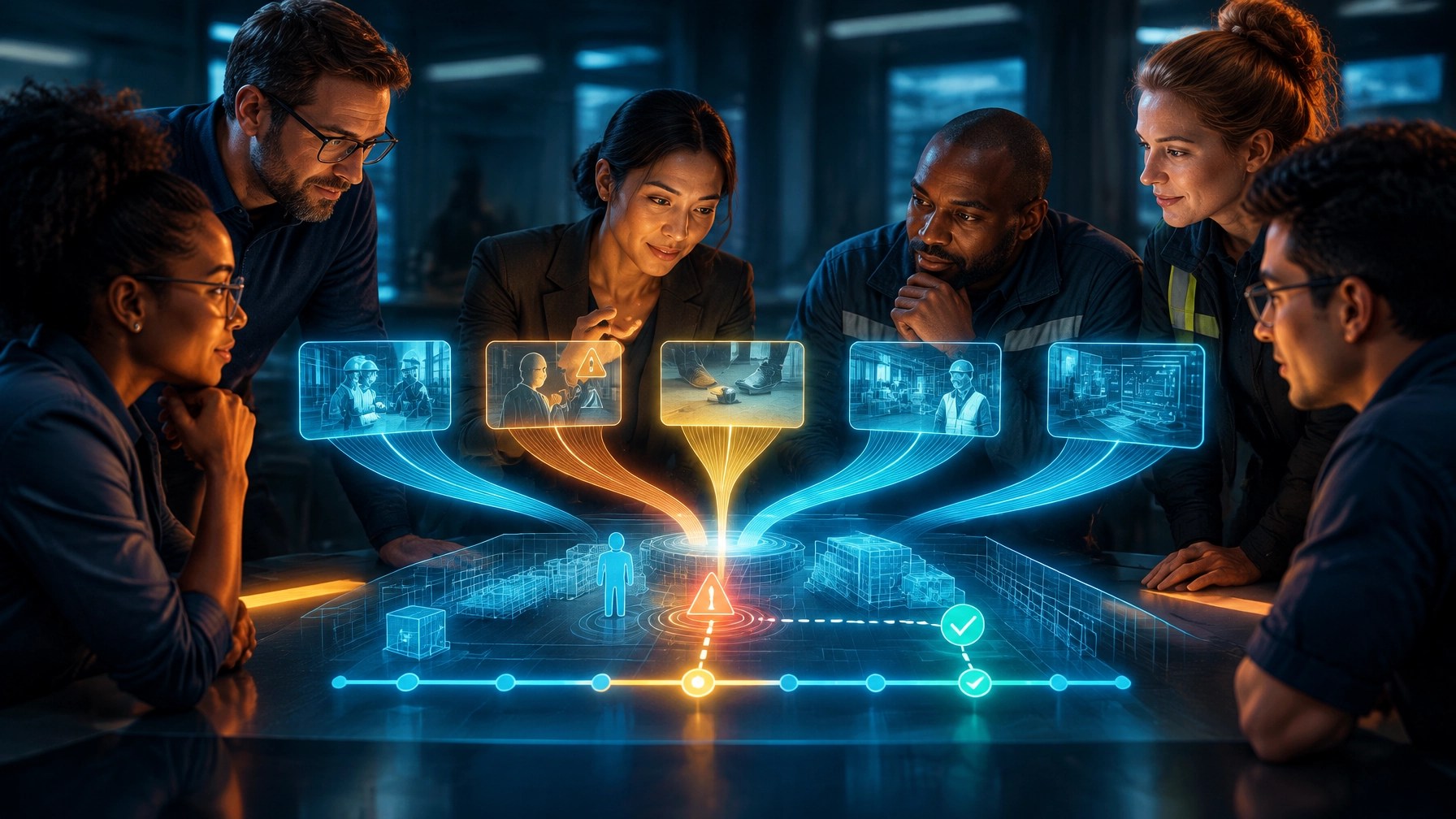
The ordinary work that keeps the system alive
Safety Differently and Safety-II pull my attention toward the work that succeeds repeatedly.
Not because failure is unimportant. Because failure is often a distorted window into a system that has been adapting for years.
Workers notice a warning light before it becomes a shutdown. They alter the sequence when a tool is unavailable. They coordinate around a staffing gap. They slow down a task when the environment feels wrong. They prevent harm through judgment that never appears in a procedure or dashboard.
That adaptation is not noise. It is operational knowledge.
If leaders study only major incidents, they miss the conditions that allow people to succeed most of the time. They also miss the moment when a useful adaptation becomes an unsafe workaround, when a temporary exception becomes routine, or when the person who used to catch the problem is no longer on the shift.
This is where the PERSONA patterns show up in the room without announcing themselves.
One person goes silent because speaking across a professional boundary has previously cost too much. Another keeps solving the same problem alone because the workaround has become part of their identity. Someone else accepts the recurring inconvenience as normal because no serious injury has followed it yet. A supervisor sees the pattern but decides the evidence is not severe enough to justify escalation.
The organization has plenty of intelligence.
It has not created a reliable way for that intelligence to meet.
For high-risk work, learning also needs a physical path to interruption. A worker should not have to publicly defy a senior person to stop a task. A physical veto card, placed where the work occurs, can give any authorized worker a visible and immediate way to pause the operation. For the highest-consequence tasks, dual-key authorization can require two people to confirm that conditions are safe before work continues.
Those controls do more than stop an incident. They reveal where the organization has made stopping difficult.
The lesson has to change something
A review is not complete because the report is closed.
It is complete when the organization can show what changed in the work, who owns that change, and how the people closest to the task will know whether it helped.
That may mean changing a procedure. It may mean removing a conflicting target. It may mean redesigning a handoff, altering staffing, improving equipment fit, or clarifying who has authority to stop the work. Sometimes it means admitting that the original data was too thin to support a confident conclusion.
The measure I trust most is not how many incidents the organization has collected.
It is whether a worker can point to a changed condition and say, “That happened because we learned from what occurred.”
The source study is available through PubMed. Its central warning reaches beyond healthcare: robust information dissemination is an important condition for learning, but it cannot overcome competing values, blocked conversations, and systems designed to privilege severity over insight.

Field Note: The Learning-Rich Event Review
Choose one recurring risk from the last 90 days, including a near miss, minor deviation, successful recovery, or repeated workaround that did not meet the organization’s threshold for a formal investigation.
Pull the original report, but do not stop there. Speak with the person closest to the work, the person who received the handoff, the supervisor responsible for the conditions, and the person who would have to authorize a change. Ask each person what they noticed, what they expected, what they changed, and what made speaking up easier or harder.
Record whose perspective is present in the official account and whose perspective is missing.
Trace the event through the policy, staffing model, equipment, workload, communication path, privacy rule, professional boundary, and approval process. Mark every point where information was delayed, softened, blocked, or disconnected from the person able to act.
Write one sentence describing the lesson in operational terms. Then write one specific change that will make the next occurrence easier to detect, interrupt, or recover from.
Assign an owner and a review date. If the task carries serious injury or fatality potential, place a physical veto card at the work location and require dual-key authorization before the task resumes.
Return the result to the people who provided the information. Ask whether the change reflects what they actually experience, not merely what the report says.
What lesson has your organization been collecting for years without changing the conditions that keep teaching it?
Scenes in this article are illustrative composites, not accounts of specific events.