
Jack Welch once said, “The most important quality of leadership is intellectual honesty. The reality principle : the ability to see the world as it really is, rather than as you wish it were.”
The air in the boardroom is thin, scrubbed clean by a high-end filtration system that hums a low, expensive frequency. On the seventy-fifth floor, the city below is a blur of neon and movement, but inside, time has stilled around a single, glowing slide. The line on the graph is a beautiful, descending slope: a deep forest green that signals success, compliance, and safety. I watch the CEO lean back, a ghost of a smile touching his lips. He’s looking at a record of zero lost-time incidents for the quarter. He sees a win. He sees a bonus. He sees a culture that is finally "getting it."
Across the table, the Safety Director’s knuckles are white against the edge of a mahogany desk. He knows about the two near-misses on the production floor that never made it into the software because the supervisors didn't want to break the "streak." He knows about the forklift that clipped a structural beam yesterday, an event that was laughed off over coffee rather than logged into the system. He knows the green line is a lie, a thin veil draped over a jagged reality of narrow escapes and silenced alarms.
This is the moment where the reality principle dies. It dies not because of a lack of data, but because of a neural trade-off that happens in milliseconds, deep within the architecture of the human brain.
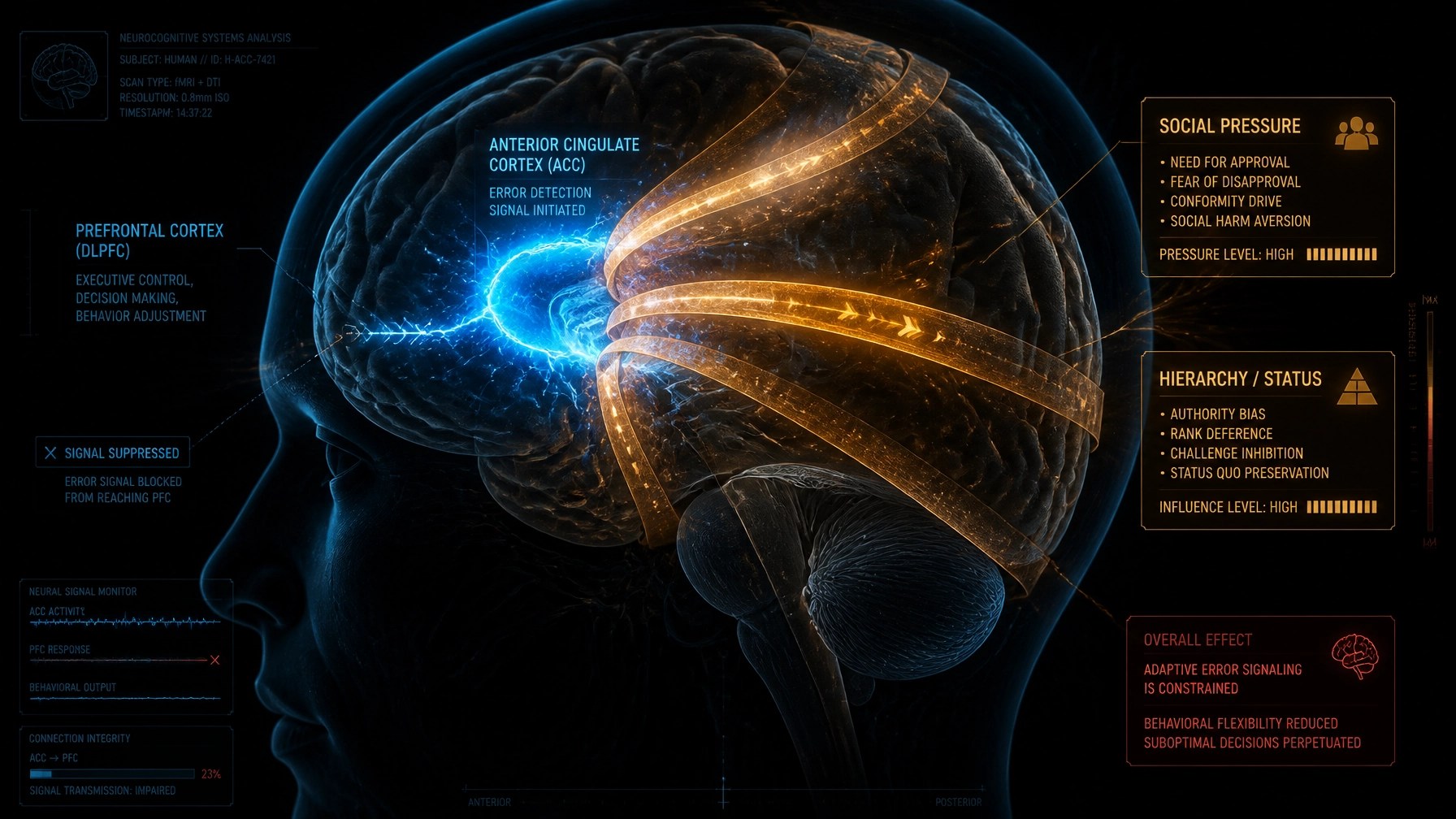
Inside the Safety Director's skull, the anterior cingulate cortex (ACC) is screaming. This region is the brain’s primary error-monitoring circuit, the neural watchtower that detects a mismatch between what we expect and what is actually happening. When the CEO celebrates that green line, the Director’s ACC fires a rapid electrical pulse: an error-related negativity (ERN) wave: that signals a massive discrepancy. Reality is red; the slide is green.
But the ACC does not operate in a vacuum. It is deeply integrated with the social brain. As the Director opens his mouth to speak, a different circuit activates. The orbital frontal cortex and the amygdala weigh the social cost of shattering the CEO’s illusion. To speak up is to introduce conflict, to kill the celebratory mood, and to potentially mark himself as the "problem" in a room full of people who just want to be told they are winning. The social threat of hierarchy overrides the neural signal of the error. The blue light of the ACC's warning is smothered by the amber glow of social preservation. He closes his mouth. He nods. He chooses the shortcut of silence over the honesty of the reality principle.
We are often told that safety is about systems, but it is actually about the courage to maintain an honest relationship with reality. Arguing with reality only ever costs you, and so does wishing things had happened differently. In that boardroom, the entire leadership team is arguing with reality. They are wishing for a world where safety is a descending line on a chart rather than a messy, constant struggle with entropy and human error. The pain of that argument won’t be felt in the meeting; it will be felt on the factory floor three months from now when a “near-hit” finally becomes a “direct-hit.”
I see this play out in high-performance organizations every week. Leaders become addicted to the lagging indicators: the data that looks backward at what didn't happen. It’s comfortable. It’s rewarding. It validates the narrative of the Achiever who needs to see the win. But lagging indicators are the graveyard of safety science. They tell you that you were lucky yesterday, not that you are safe today.
Real safety lives in the uncomfortable data. It lives in the "weak signals": the weird vibration in the turbine, the hesitant look on a technician’s face, the surge in near-miss reports that leaders often mistake for a "problem" when it is actually a sign of a healthy, reporting culture. When you celebrate a lack of reports, you aren't celebrating safety; you are celebrating the fact that your people have learned to hide the truth from you. You have created a culture of The Silence, where the neural error signals are suppressed before they can ever reach your desk.
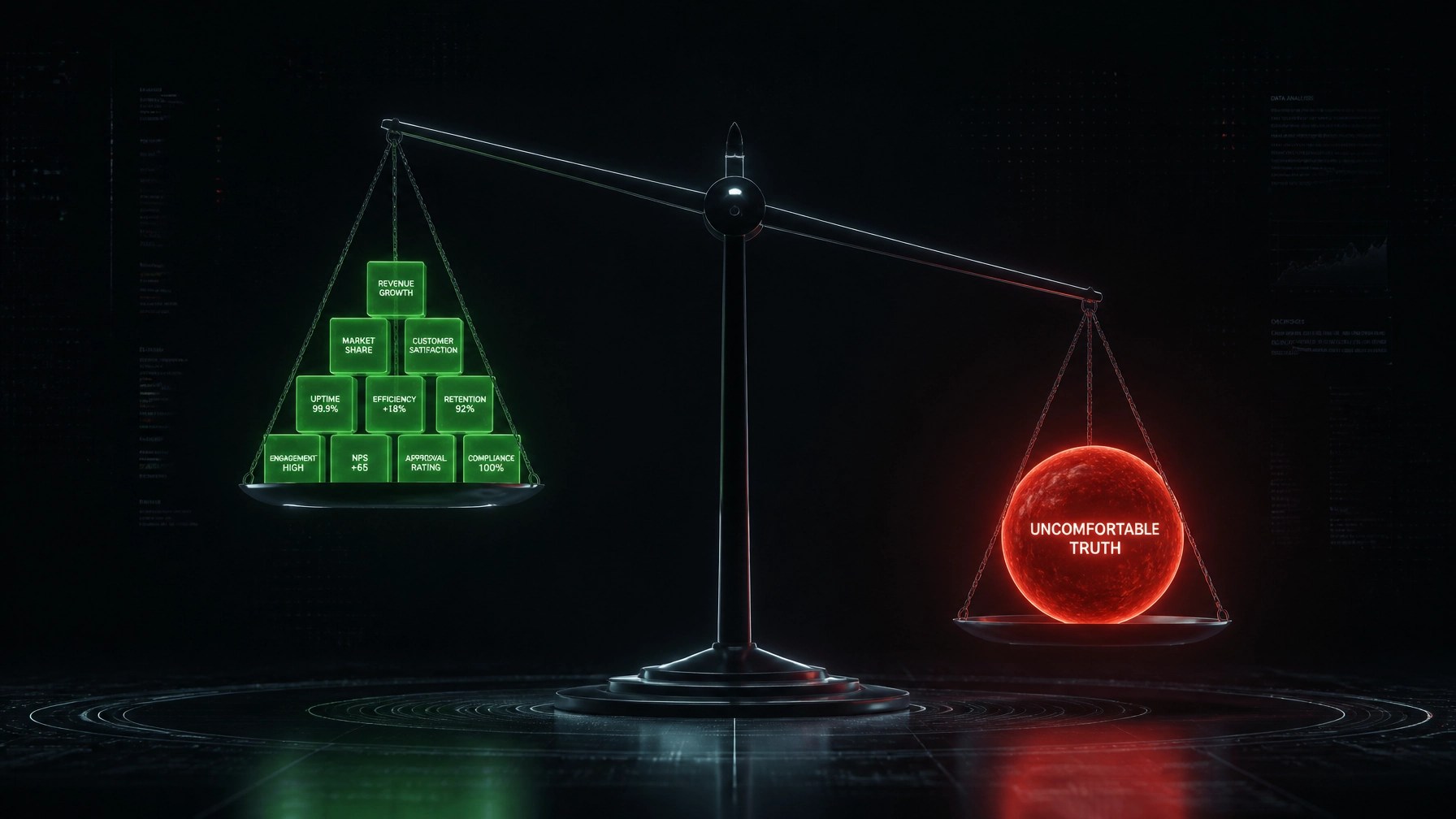
Intellectual honesty requires you to look at the scale and realize that one heavy, uncomfortable truth outweighs a thousand light, comfortable lies. If your quarterly review feels good, you are probably looking at the wrong data. A true safety review should feel slightly agitating. It should provoke the "change pain" that occurs when the brain’s error detector forces us to update our mental models. It should be a confrontation with the gap between the work we imagine is happening and the work that is actually being done in the heat and the noise of the real world.
When we ignore the reality principle, we are essentially asking our employees to perform a daily act of cognitive dissonance. We ask them to "stay safe" while simultaneously signaling that we only want to hear the good news. This creates a state of chronic stress, a polyvagal collapse where the nervous system realizes that the only way to stay "safe" in the hierarchy is to stay silent about the hazards. We trade physical safety for social safety, and we call it a "successful quarter."
The shift requires a radical re-tuning of the leader’s own internal error-monitoring systems. It requires an environment where the ACC can fire without fear of the amygdala’s social backlash. It means rewarding the person who brings the "bad" data to the table, recognizing that they are the only ones actually practicing the reality principle.

Sanity, as Margaret Wheatley points out, is an honest relationship with reality. In a corporate world obsessed with optics and the "green-status" dashboard, sanity is a revolutionary act. It is the ability to look at a room full of celebrating peers and say, "We are missing the signal."
Field Note: The Reality Ratio
In your next safety review or operational update, perform a silent audit of the information being presented. This is a measure of your organization's commitment to the reality principle.
- The Audit: Divide your meeting time into two categories. Category A is data that confirms you are doing well (lagging indicators, completed trainings, "zero-event" streaks). Category B is data that makes you uncomfortable (near-misses, equipment failures, employee concerns, deviations from standard procedure).
- The Ratio: If Category A occupies more than 80% of the meeting, you are in a state of "Social Suppression." You are reinforcing the silence.
- The Adjustment: For every "green" slide presented, explicitly demand a "red" slide: a specific example of something that went wrong or almost went wrong in that same period.
- The Reward: Publicly thank the individual who provides the most "uncomfortable" piece of data. This signals to the collective brain that the social cost of truth-telling has been removed.
What is the one piece of safety data in your organization that you know is true but uncomfortable to look at : and what would change if you looked at it every day until it stopped being uncomfortable?
Scenes in this article are illustrative composites, not accounts of specific events.