
The rhythm is perfect. Elias doesn't look at the lever; he feels the vibration in the floor, a low hum that tells him the pressure is peaking. Three months ago, he found it: the thirty-second gap. If he bypasses the secondary guard reset, the cycle doesn't stop. It just flows. He saves thirty seconds every six minutes. In an eight-hour shift, he’s giving the company an extra forty minutes of pure production. He is the star. The foreman points to him when the new hires arrive. He’s the one who never misses a target, the one whose metrics are a straight line of ascending green.
Elias has performed this exact shortcut three thousand times.
Three thousand successes have carved a canyon in his motor cortex. Each time the cycle finishes without an incident, his brain receives a hit of reward: a chemical "good job" that reinforces the Go pathway. The physical guard he’s bypassing has become a ghost. It isn't a safety feature to him anymore; it is a friction point. It is an obstacle to the efficiency his brain is now wired to crave. He isn't being reckless. He’s being the best version of himself that the system has asked for.
The system hasn't just permitted the shortcut; it has subsidized it. Every time Elias hits the production bonus, the neural loop tightens.
We think of risk-taking as a character flaw, a conscious choice to be "bad." It isn't. For the Achiever, risk-taking is often a compensatory response to a low baseline dopaminergic tone. When the brain’s internal reward circuitry is set to a lower frequency, it seeks out external stimulation to bridge the gap. The "buzz" of beating the clock, the satisfaction of a perfectly optimized movement, the silent pride of being the fastest on the floor: these aren't just work habits. They are neurochemical requirements. Elias is chasing the dopamine hit that a standard, "safe" pace cannot provide.
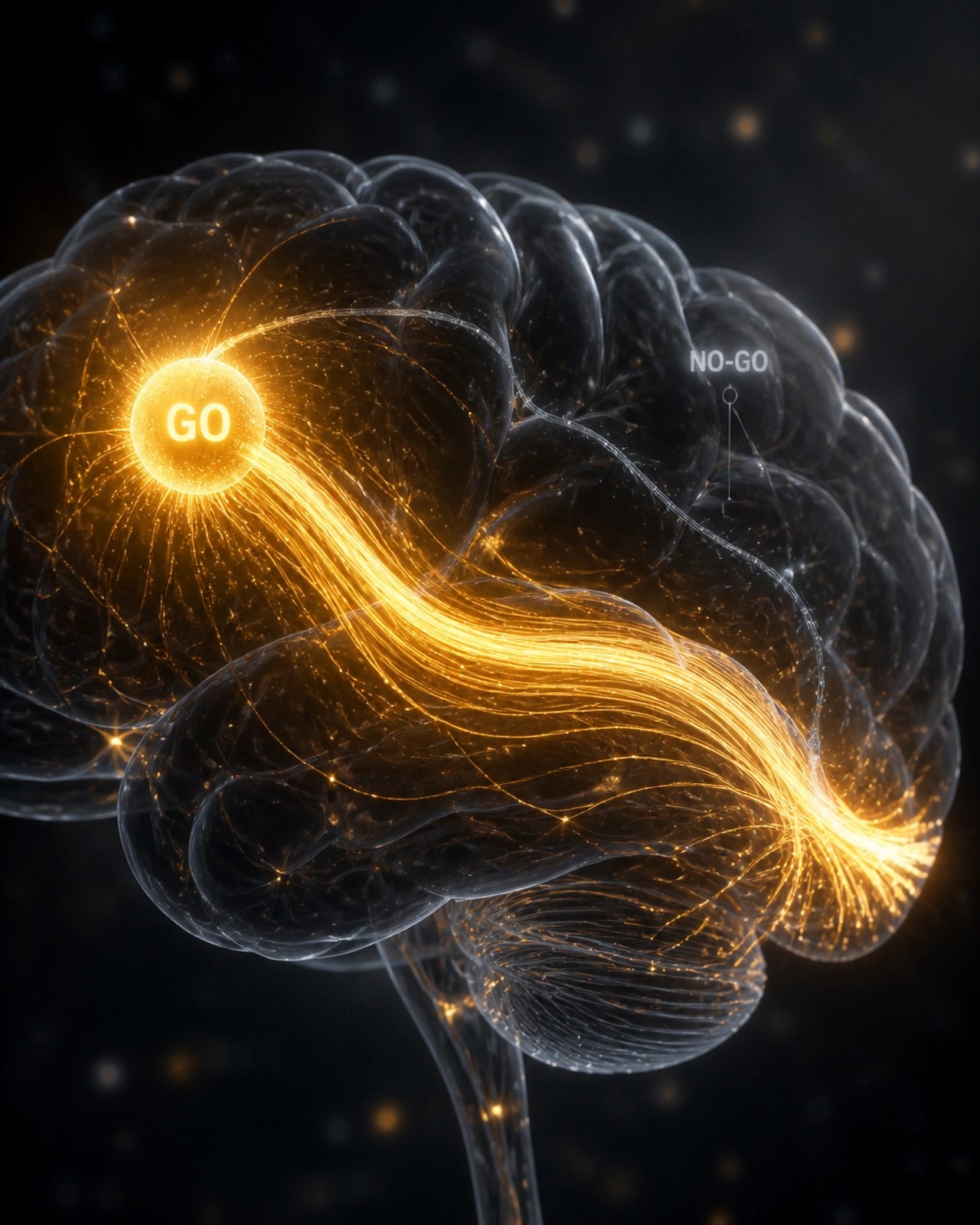
His brain has effectively silenced the No-Go pathway. In the basal ganglia, the Go and No-Go pathways usually act as a check-and-balance system. One initiates action; the other suppresses it. But three thousand repetitions of a rewarded shortcut have turned the Go pathway into a blindingly bright fiber optic cable, while the No-Go pathway: the one that should flag the missing guard: has withered into a thin, grey thread.
He doesn't see the danger because his brain has literally lost the hardware to process the stop signal.

Then the pressure ramps up. The quarterly targets shift. The "normal" speed becomes the "slow" speed. This is where the objective judgment of risk evaporates. Under acute time pressure, the brain's ability to encode risk coarsens. It stops being a calculation and starts being a blur. The prefrontal cortex, which should be weighing the probability of a mechanical failure against the benefit of thirty seconds, gets sidelined.
The Achiever under pressure isn't deciding to be unsafe; they are incapable of seeing the "unsafe" as a reality.
I think about the distinction between belief and knowingness. We tell ourselves that the Achiever “believes” the shortcut is safe. But it’s deeper than that. Belief always carries a trace of doubt. If you believe something, there is a shadow of a possibility that you might be wrong. But Elias doesn’t have belief. He has knowingness. Knowingness has no doubts. His three thousand successful repetitions have moved the shortcut from a “calculated risk” to a “known truth.” To him, the shortcut is the way the machine works. The safety manual is a fictional document written by people who don’t understand the rhythm of the floor.
He "knows" he can make the jump. He "knows" the guard doesn't matter. He "knows" he is the best because the metrics say so.

The danger of the Achiever is that they are the person we want to be. They are the ones we promote. They are the ones we hold up as the standard. We build systems that reward the Go pathway and wonder why the No-Go pathway fails when things go wrong. We provide the dopamine for the shortcut and then act surprised when the operator stops seeing the hazard.
Three thousand times, the system was lucky. On the three thousand and first time, the machine doesn't care about the metrics. It doesn't care about the dopaminergic tone of the operator. It only cares that the guard isn't there.
Field Note: The Achiever Shortcut Audit
- Identify the top 5% of performers in your high-risk areas: the ones whose efficiency consistently outpaces the average.
- Observe them during peak production windows. Look for the "fluidity" of their movement. Where the movement is most fluid is where the shortcut usually lives.
- Ask the question: "How many times have you done it this way without an incident?"
- Recognize that the answer (e.g., "Thousands") is not a metric of safety; it is a metric of neural reinforcement.
- Stop trying to "train" the risk out of the Achiever. You cannot out-train a dopamine loop.
- Redesign the physical or digital workflow so that the compliant path is physically the fastest path. If the safe way isn't the most efficient way, the Achiever’s brain will eventually find a way to bypass it.
If the Achiever's 3,000 successful shortcuts have weakened the neural pathway that should tell them to stop, what is the cost of the system that rewards efficiency over verification: and who pays when the 3,001st shortcut is the one that fails?
Scenes in this article are illustrative composites, not accounts of specific events.