
Safety leaders often talk about culture as if it were intangible: a slogan, a values poster, or a tone set from the top. In practice, I see something far more measurable.
Safety culture is a biological state.
At the executive level, that distinction matters. If people across an organization are operating under chronic stress, the quality of attention, judgment, communication, and risk recognition declines. In other words, culture is not just what people say they value. It is what their nervous systems allow them to do under pressure.
For high-performance organizations, this is the leadership conversation worth having: not whether safety is important in principle, but whether the operating environment is biologically compatible with safe performance.
Why the Brain Changes the Safety Conversation
The core neuroscience is straightforward. The amygdala, a small structure in the brain involved in threat detection, is constantly scanning for danger. That danger can be physical, but it can also be social or operational: a missed deadline, public criticism, uncertainty, or escalating performance pressure.
When the brain interprets those signals as threat, it can trigger what many people recognize as an Amygdala Hijack. In that state, the prefrontal cortex: the region responsible for planning, sound judgment, impulse control, and hazard recognition: becomes less effective.
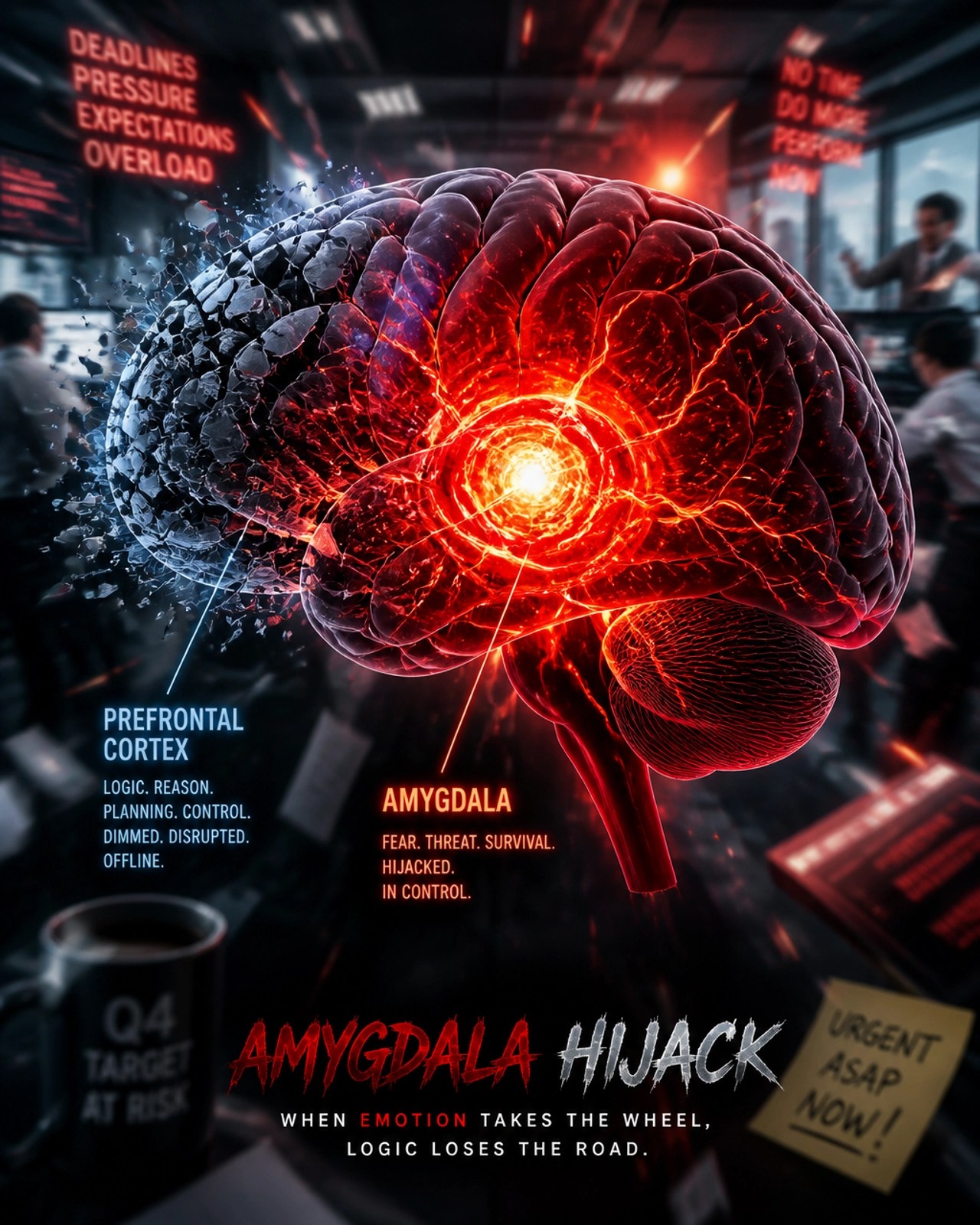
This is where the safety message becomes highly practical. If an employee is cognitively narrowed by perceived threat, procedures alone will not deliver the outcome leadership expects. The issue is not motivation. The issue is capacity.
That is why Psychology Before Procedures™ is not a slogan to me. It is an operating principle. Before expecting precision, consistency, or high-quality decision-making, leaders have to understand the biological conditions under which those outcomes are even possible.
Cortisol and the Cost of Chronic Pressure
When threat is sustained, the body increases stress hormones such as cortisol. In the short term, that response can be useful. In the long term, chronic cortisol elevation becomes a performance and safety problem.
For executives, the implications are significant:
- Attention narrows. People are more likely to miss peripheral risks, weak signals, and small anomalies before they become large failures.
- Memory becomes less reliable. Training retention suffers, especially in environments already overloaded with information and administrative demand.
- Shortcuts become more appealing. Under pressure, people are more likely to trade rigor for speed in an attempt to relieve the immediate threat.
This is one of the most overlooked realities in enterprise safety. Organizations often demand high reliability while creating conditions that biologically undermine it. If the environment drives chronic threat activation, even experienced teams will show more errors, more reactivity, and less adaptive thinking.
Psychology Before Procedures™
The next step is not to abandon systems. It is to sequence them correctly.
I believe in Psychology Before Procedures™ because regulated nervous systems support better execution. When people feel safe enough to think clearly, they are more capable of applying training, participating in dynamic risk assessment, and responding to change without cognitive shutdown.
Tools such as the Vagal Safety Ladder offer a useful framework for understanding whether people are operating in a mobilized fight-or-flight state or a more regulated, socially engaged state.
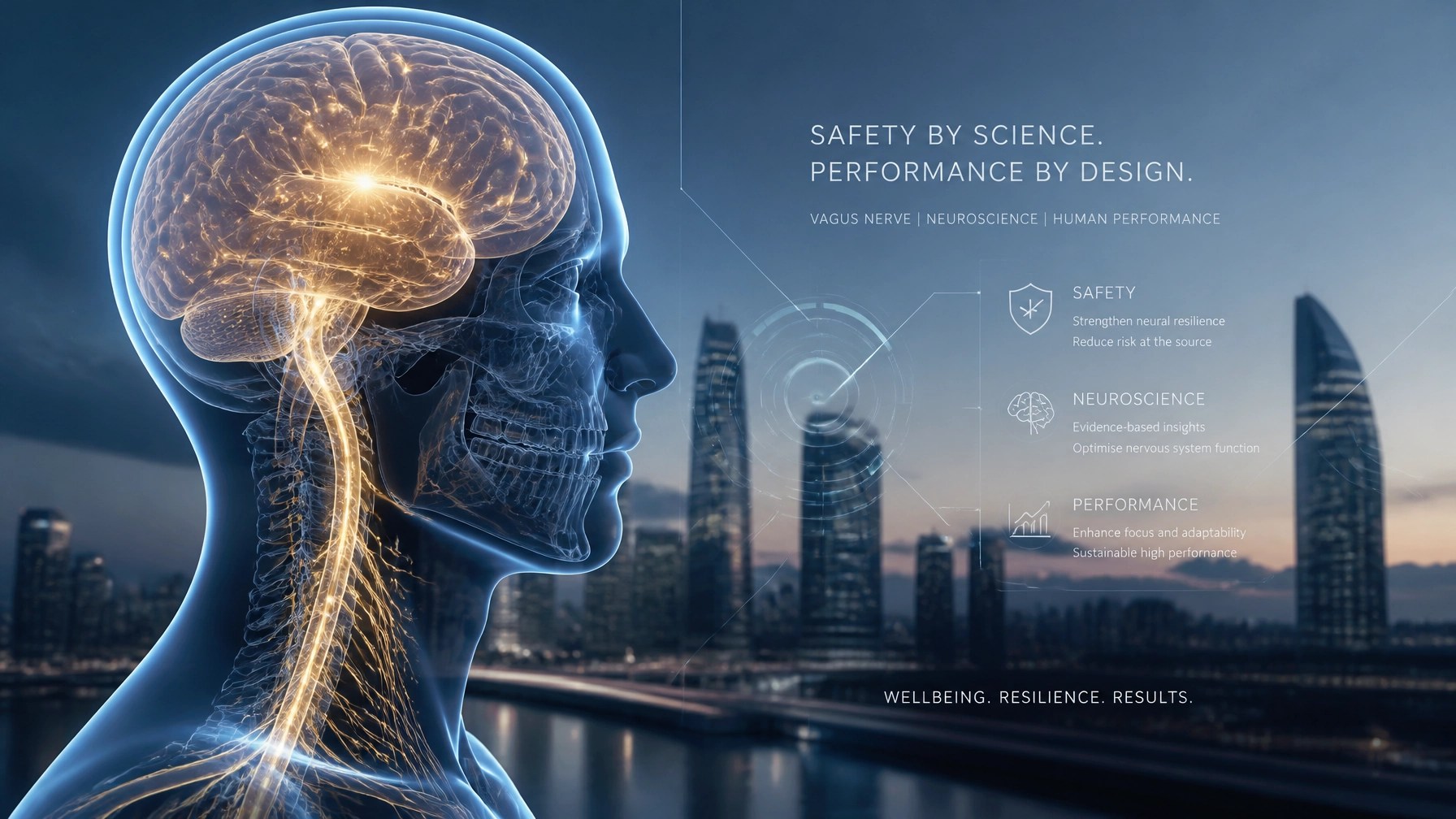

That distinction matters because a regulated state supports curiosity, pattern recognition, collaboration, and better judgment. In practical terms, that means a pre-task risk review or field-level safety check becomes more than a compliance ritual. It becomes cognitively real.
People Before Paperwork™
This brings me to People Before Paperwork™.
Many organizations have invested heavily in safety management systems, reporting structures, and documentation requirements. Some of that structure is necessary. But when the administrative burden becomes excessive, it adds friction, cognitive load, and fatigue.
From a leadership standpoint, that is not a minor inconvenience. It is a design flaw.
If teams spend disproportionate time feeding the system rather than engaging with the work, the organization may be measuring activity while eroding awareness. That is why I keep coming back to the quality of human interaction. Are leaders only reviewing forms, or are they improving the conditions under which people can think, speak up, and identify risk early?
The Quantum Safety lens is useful here because it shifts attention from document completion to the quality of connection, perception, and response inside the work itself.

When a leader slows down long enough to be present, listen, and engage directly, co-regulation becomes possible. Threat signaling can decrease. Cognitive flexibility can return. And that creates the conditions for better safety decisions before an incident ever occurs.
A More Executive Approach to Safety Strategy
The strategic question is no longer whether organizations need procedures, technology, or predictive systems. They do. The question is whether those investments are being matched by equal attention to human biological readiness.
That is where modern safety leadership can differentiate itself.
A more effective executive approach includes:
- Reducing operational friction. If reporting systems are slow, confusing, or excessively burdensome, they create avoidance and degrade reporting quality.
- Paying attention to biological readiness. Tools such as Oura Ring can support visibility into sleep, recovery, and readiness where appropriate for the work context.
- Measuring psychological safety. Instruments like the Fearless Organization Scan can help leaders understand whether people genuinely feel safe to speak up.
- Strengthening real-time communication. Platforms like Slack and Microsoft Teams can support faster, lower-friction learning loops when used intentionally.
None of these tools replace leadership. They support it. The real shift happens when leaders recognize that the human nervous system is not a side issue in safety performance. It is central to it.
The Business Case for a Regulated Culture
For executive teams, the return on this approach is not abstract.
When people are chronically stressed, organizations absorb the cost through incidents, rework, disengagement, burnout, turnover, and degraded decision quality. When people are more regulated, the enterprise gains better attention, stronger communication, faster learning, and more resilient performance under pressure.
That is why I see regulated culture as a serious business issue, not a soft one.
When leaders treat safety culture as a biological reality instead of a branding exercise, they position the organization to become more reliable, more adaptive, and more trustworthy at scale. They also move closer to what I believe matters most: People Before Paperwork™ and Psychology Before Procedures™.
Safety culture is not just something an organization promotes. It is something the body experiences.
And if I want better safety outcomes, that is where I start.
If this perspective aligns with how your organization is thinking about leadership, risk, and performance, visit SafetySenseinc.com or explore Janel’s books for deeper insight into building safer, more biologically intelligent workplaces.
Scenes in this article are illustrative composites, not accounts of specific events.