
The crew crosses the exposed walkway before the first shift has properly warmed up.
Boots strike the same metal grating. One worker turns sideways at the same narrow gap. The unguarded edge sits just beyond the shoulder, close enough to make the body lean away without anyone consciously deciding to move.
They have crossed it hundreds of times.
No one has fallen. No one has been caught. No one has even stopped long enough to call it an emergency.
They are not reckless. Their nervous systems have done exactly what nervous systems are designed to do.
A threat appears. Nothing bad follows. The brain updates.
Then the same threat appears again. Still nothing.
Again. Nothing.
The pulse that once jumped at the exposed edge begins to settle. The eyes stop checking the gap. The body stops preparing for impact. The crew does not consciously vote to become careless. Alarm simply becomes expensive, unnecessary, and eventually absent.
That absence matters.
The missing alarm is being produced by the brain
Habituation is often described as if a worker has stopped paying attention. That explanation quietly turns a biological process into a character judgment.
The nervous system is not merely failing to receive the signal. It is learning that the signal does not predict harm.
This distinction is central.
When a threat cue is repeatedly encountered without the expected negative consequence, the brain begins forming a new association: this cue is safe enough. In fear research, that process is called extinction learning. The original danger memory is not necessarily erased. A competing safety memory is built, and the system becomes less likely to activate the full defensive response when the cue returns.
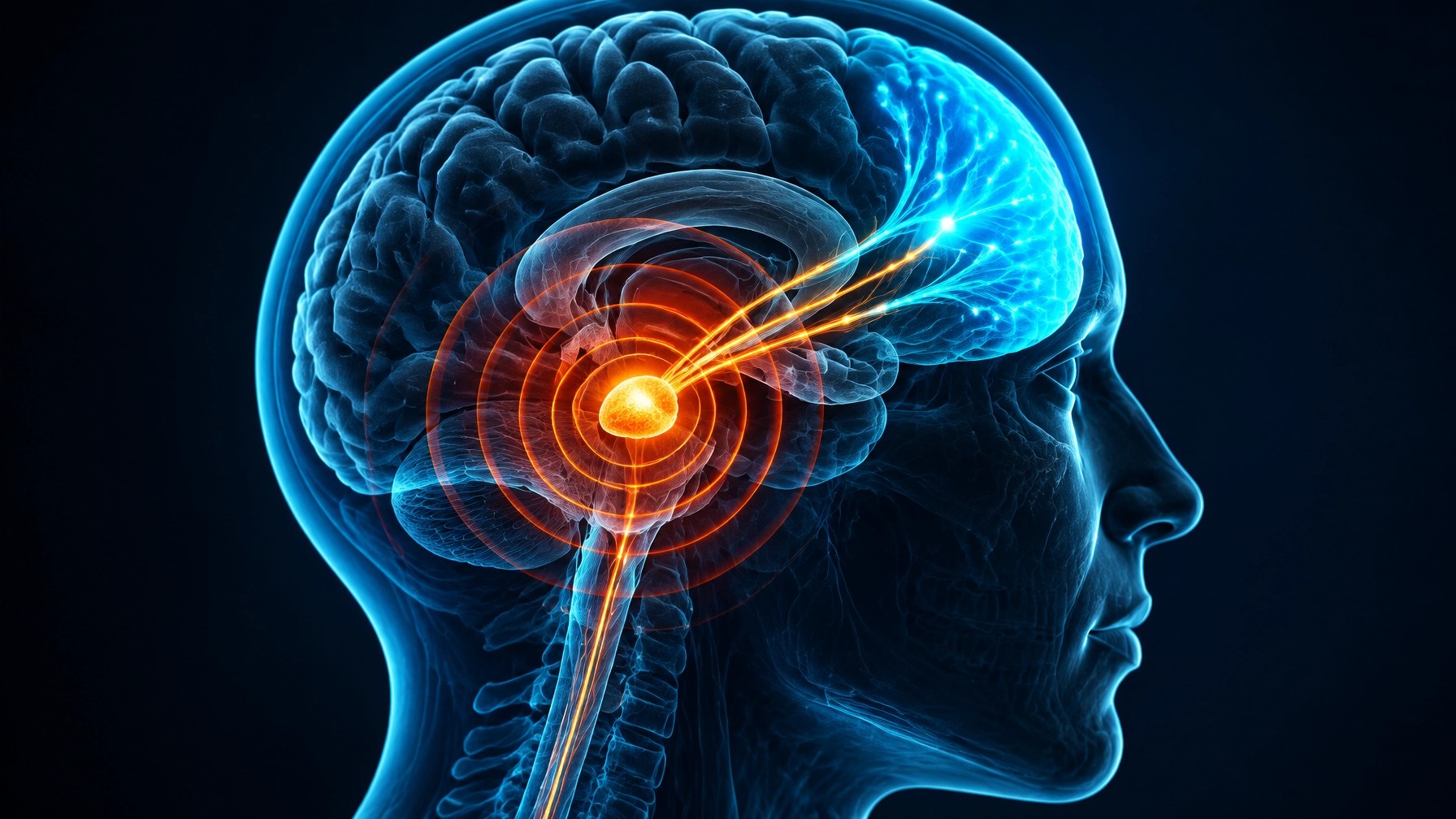
The amygdala sits inside that process as a rapid threat-learning structure. It helps assign emotional weight to what the body encounters, especially when the cost of missing danger could be catastrophic. But the amygdala is not a permanent alarm bell. Its activity changes with experience.
A recent Science Advances study using transcranial ultrasound stimulation gives this mechanism sharper edges. Researchers modulated the human amygdala during threat conditioning and found that altering its activity changed how quickly threat responses were acquired and how quickly extinction began. The effect was most visible in the early phase: the first moments when the brain is deciding whether a cue deserves alarm.
That is the part leaders should sit with.
Repeated exposure without consequence does not simply make people lazy. It teaches the threat system that the cue is not predictive of harm. Fear attenuates because learning is occurring.
The crew at the walkway is not ignoring the hazard in the ordinary sense. Their brains have revised the meaning of the hazard.
The evolutionary mismatch is severe
The amygdala was shaped in environments where one encounter with a threat could be enough.
A movement in the brush. A sudden drop. A predator that appeared once and never needed to appear again.
There was no industrial staircase to cross eight hundred times per week. No temporary guardrail removed for production access. No forklift passing within inches of a pedestrian lane every afternoon. No pressure valve that hissed beside the same operator for ten years before failing on the one day the seal gave way.
The ancient system was not designed for a hazard that can be presented a thousand times before it kills someone.
That mismatch creates a dangerous paradox: the natural, healthy, predictable response to repeated safe exposure is the response that can make a workplace less safe.
The crew becomes calmer because calm is efficient. Attention is redirected to the next task. The body no longer spends energy preparing for an outcome that has not occurred. The shortcut feels reasonable because the nervous system has accumulated evidence in its favor.
This is why near misses can be so misleading.
From a reporting perspective, a near miss may look like evidence that the crew handled the situation successfully. From a learning perspective, it may be another extinction trial. The hazard was present. The consequence did not arrive. The brain stored the absence of harm.
Do that often enough and the gap stops feeling like a gap.
Normalization of deviance begins below the level of culture
Normalization of deviance is usually described as a cultural drift. People tolerate a shortcut. Supervisors accept a workaround. The organization gradually moves the boundary of acceptable performance.
That description is not wrong, but it begins too late.
The drift is downstream of an automatic process.
Every repeated safe passage strengthens the prediction that the unsafe condition is survivable. Every uneventful shift rewards the brain for reducing alarm. The crew’s calm then becomes social evidence for everyone else: if experienced people are not reacting, perhaps there is nothing to react to.
A new worker watches the veterans cross the gap. The behavior is transmitted before the procedure is read. A supervisor sees no incident and stops interrupting. A leader receives no complaint and assumes the control is working.
The danger is not just that one person becomes desensitized. The whole operating system can begin treating the absence of harm as proof of safety.
That is where the Swiss Cheese Model becomes more disturbing. The layers do not merely contain holes. Human attention, judgment, voice, supervision, and intervention are often the layers. When the crew stops feeling the hazard, the holes widen across several defenses at once.
The worker does not report the edge because it no longer feels urgent.
The supervisor does not escalate it because no one appears concerned.
The manager does not fund a physical correction because the activity has continued without loss.
The procedure remains intact on paper while the living barrier has thinned.

This is why “be more vigilant” is such a weak response. Vigilance asks a human nervous system to keep producing an alarm that experience has taught it to suppress.
The correction has to change the learning conditions.
Reminders do not reverse extinction
A poster can describe the edge. A toolbox talk can repeat the rule. A supervisor can tell the crew to pay closer attention.
None of those changes the contingency.
The physical hazard remains in the same place. The same crossing still produces the same non-event. The brain receives the same message: this condition is present, and nothing happens.
Extinction learning is interrupted by new predictive information or by a change in what follows the cue.
That means the first intervention should be physical. Move the walkway. Install the guard. Remove the route. Change the access point. Build a barrier that does not depend on a worker feeling sufficiently afraid on the 700th crossing.
If a high-risk task must continue, introduce deliberate variation into the exposure. Change the access condition. Require a different authorization state. Rotate the route only when the alternative is demonstrably safer. Make the hazard visible through changing physical cues without turning the worksite into a theater of warning signs.
Variation matters because complete predictability accelerates habituation. A cue that never changes becomes background.
The contingency also has to become real again. A near miss should produce visible corrective action, not ceremonial concern. The crew needs to see that the hazard changes the system. Not because leaders are punishing the person who encountered it, but because the organization is restoring the connection between danger and consequence.
For high-risk work, I would go further. Use a physical stop-work veto card that any worker can place into the task-control point without public defiance. Pair it with dual-key authorization: two independent people must confirm that the hazard is controlled before the card is removed and the task resumes.
That design matters because it moves the intervention out of the worker’s throat and into the system. No one has to stand alone in front of authority and announce that the familiar hazard is dangerous again. The control carries the voice.
This is the logic behind Psychology Before Procedures™ and the NISOS™ observation framework: behavior is evidence of the conditions surrounding the person, not a convenient explanation for why the person failed. If a crew is calm around a serious hazard, I do not begin by asking why they stopped caring. I ask what the system has repeatedly taught their brains to expect.
Field Note: The Habituation Countermeasure
- Identify the hazards your team crosses, enters, handles, or works beside hundreds of times without consequence. Those are the hazards the crew may no longer feel.
- Change the physical conditions first. Install the guard, remove the exposure, redesign the route, add an interlock, or separate people from the energy source.
- Introduce deliberate variation so the cue does not become completely predictable. Vary access controls, verification points, or task conditions without creating new risk.
- Use engineered interruptions at defined intervals. Stop the task, inspect the control, confirm the hazard, and require a visible reset before work continues.
- Give every worker a physical stop-work veto card that can halt the task without requiring a public confrontation.
- Require dual-key authorization before restarting high-risk work. One person should not be able to normalize the condition and authorize its continuation alone.
- Treat every near miss as evidence about the system’s learning environment, not as proof that the worker successfully managed the danger.
- Never confuse a calm crew with an aware crew.
A hazard crossed a thousand times can become more dangerous precisely because it no longer feels dangerous.
Which hazard has your team crossed so many times that their brains have stopped producing the alarm?
Scenes in this article are illustrative composites, not accounts of specific events.