
The vibration starts in the phone on the mahogany desk, a sharp, staccato buzz that cuts through the artificial quiet of the executive suite. Before the leader even picks it up, his jaw is already locked. His breath is shallow, caught in the upper third of his chest. He views the incoming notification not as data, but as an assault. Every email is a fire. Every delay is a personal affront. He paces the length of the glass-walled office, radiating a frantic, jagged energy that makes the air feel heavy, almost electric. He tells himself he thrives under pressure. He believes the sweat on his collar and the rapid-fire commands he barks into the receiver are the hallmarks of a high-performer. He wears his sympathetic nervous system activation like a badge of honor, unaware that he is currently the most dangerous variable in the building.
Mastery over your experience on earth starts with the realization that you control the vibration you broadcast. When you cannot control your mind and your thoughts, you cannot control your emotions. You become a leaky vessel of dysregulation. I have stood in rooms where the leader walked in and the collective heart rate of the group spiked within seconds. It wasn’t because of what they said. It was because the frequency they were broadcasting: one of urgency, threat, and chaos: became the dominant frequency of the environment. The crew’s nervous systems do not have the luxury of opting out. They are biological receivers, and they are currently being jammed by a signal that screams emergency when there is only a schedule change.

This isn’t just about morale or "company culture." It is a matter of neurological capacity. When a leader broadcasts chaos, they force everyone in their orbit to spend a massive amount of their own cognitive bandwidth simply managing the leader’s state. The team is no longer looking at the high-pressure valve or the precarious load on the crane; they are looking at the leader’s face, scanning for the next explosion, trying to predict the next shift in the atmospheric pressure. Their prefrontal cortex: the part of the brain responsible for complex decision-making and hazard detection: is being diverted to social survival.
The cost of this diversion is measurable. Research using functional near-infrared spectroscopy (fNIRS) shows that mental fatigue changes how the prefrontal cortex (PFC) works; a 2025 meta-analysis in Psychophysiology (Yan and colleagues, DOI: 10.1111/psyp.14747) pooled those studies. The PFC has limits. As task difficulty and stress increase, the PFC ramps up its oxygen consumption to keep pace. But when the load becomes chronic: when the leader’s unregulated internal state adds a layer of constant, unpredictable noise: the PFC doesn’t just plateau. It exhausts. It begins to disengage. The brain effectively “grays out” the executive functions to conserve energy, leaving the individual in a state of neural overload.
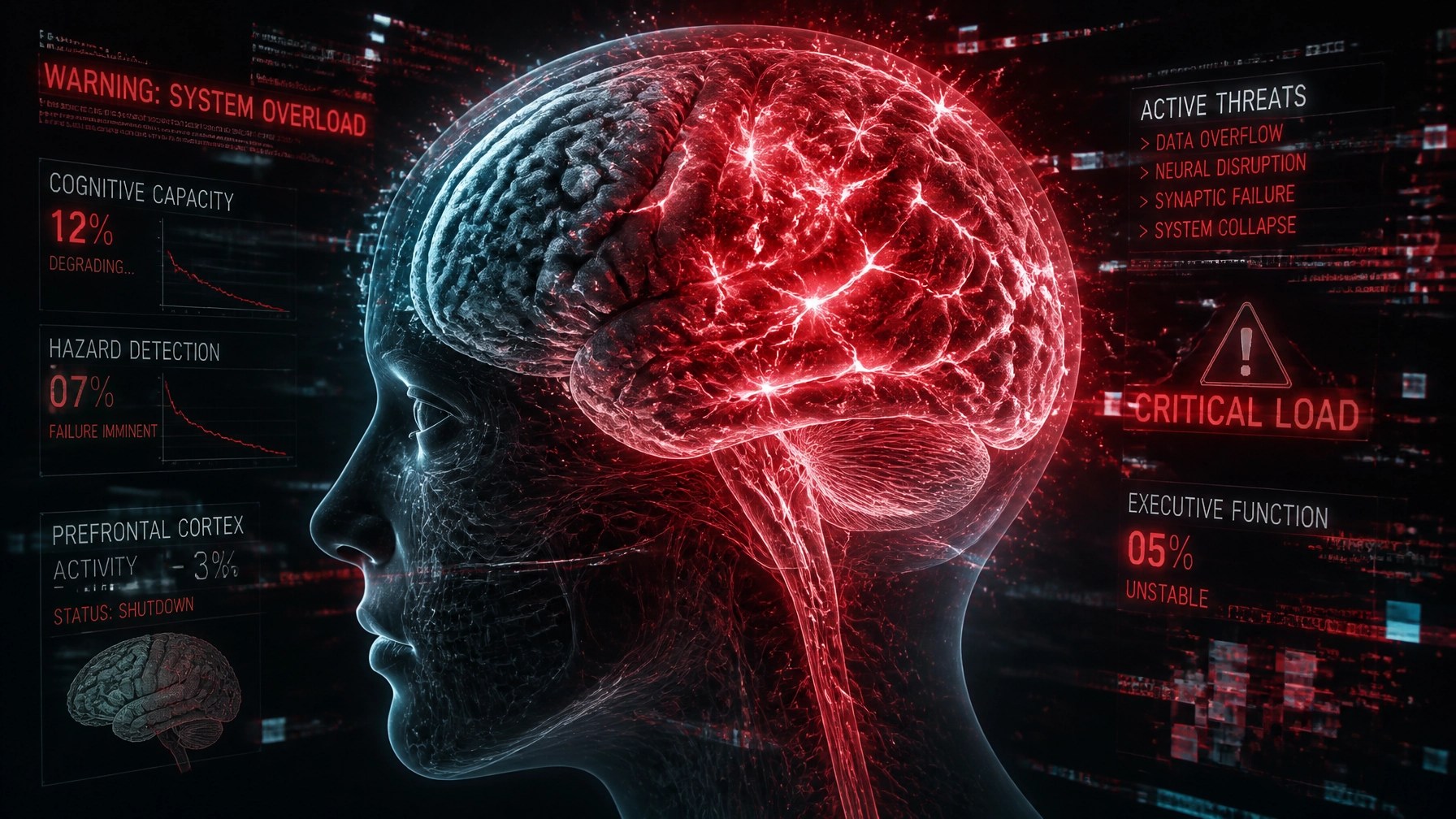
In this state of exhaustion, the crew’s ability to detect subtle signals of failure vanishes. They are physically incapable of the high-level vigilance required in high-hazard environments. I’ve seen teams miss glaring red flags: a leaking pipe, a bypassed interlock, a misaligned sensor: simply because their PFC was already depleted from three hours of navigating a leader’s frantic "broadcast." The leader believes they are driving the team toward results, but they are actually blinding them to the risks. They are arguing with the reality that human attention is a finite resource, and by flooding the environment with their own unregulated emotions, they are bankrupting the team’s safety reserves.
There is no such thing as a neutral interaction. Every time a leader speaks, or even enters a room, they are either expanding or depleting the cognitive capacity of those around them. If you are breathing like a hunted animal and seeing every setback as a crisis, you are broadcasting a frequency of threat. You are telling the brains of your workers that their primary task is to survive you, not the machine. Mastery is the ability to see things as they are without judgment, to remain neutral when the news is "bad," and to realize that it is only you who decides the charge of the information. The leader who masters their own internal vibration becomes an anchor of stability, allowing the crew’s PFC to stay online, focused, and capable of seeing the hazard before it becomes a headline.
Field Note: The Broadcast Check
To maintain the cognitive safety of your environment, you must audit the signal you are sending. Use this protocol three times daily: mid-morning, after lunch, and before the final shift change.
- The Internal Scan: Stop moving. Close your eyes for three seconds. Locate the tension in your body. Is it in your jaw, your shoulders, or the pit of your stomach?
- The Rhythm Audit: Observe your breath. If it is shallow and fast, you are currently in sympathetic activation. You are broadcasting "threat."
- The Frequency Reset: Take three breaths where the exhale is twice as long as the inhale. This signals the vagus nerve to dampen the fight-or-flight response.
- The Narrative Shift: Identify the "crisis" of the moment. State the facts of the situation in neutral terms, removing all emotional adjectives. (e.g., "The shipment is delayed four hours," instead of "This delay is a disaster.")
- The Entry Protocol: Before walking onto the floor or joining a call, ask: "If I were a sensor, what frequency would I be detecting from myself right now?" If the answer is urgency or chaos, do not engage until you have achieved neutrality.
If the frequency you broadcast determines the cognitive capacity of everyone around you, are you currently expanding or depleting your team's ability to see what they need to see?
Scenes in this article are illustrative composites, not accounts of specific events.